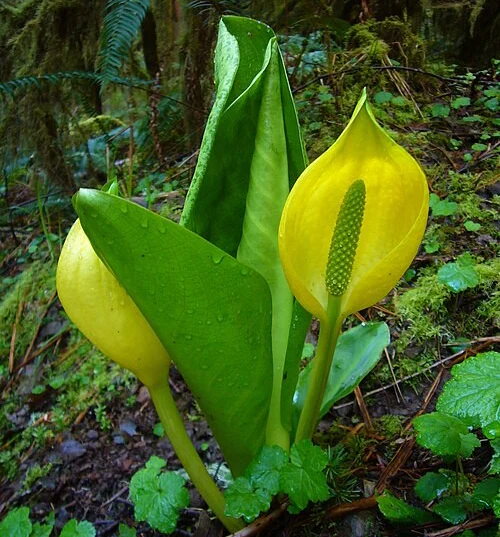
Lysichiton americanus (Western Skunk Cabbage)
Lysichiton americanus, known as Western Skunk Cabbage, displays large, leathery, paddle-shaped leaves reaching up to 1 meter long and 30 cm wide, arranged in a basal rosette that creates a striking visual in its environment. Its distinctive inflorescence consists of a spadix encased by a bright yellow or green spathe approximately 30 cm tall, blooming in early spring often before leaf emergence. The spadix emits a pungent odor similar to skunk spray, which functions to attract pollinators. This species thrives in wet, marshy habitats such as swamps, bogs, and stream banks, favoring shaded or partially shaded areas with acidic, peaty soils.
Original: $16.04
-70%$16.04
$4.81Lysichiton americanus (Western Skunk Cabbage)
Lysichiton americanus, known as Western Skunk Cabbage, displays large, leathery, paddle-shaped leaves reaching up to 1 meter long and 30 cm wide, arranged in a basal rosette that creates a striking visual in its environment. Its distinctive inflorescence consists of a spadix encased by a bright yellow or green spathe approximately 30 cm tall, blooming in early spring often before leaf emergence. The spadix emits a pungent odor similar to skunk spray, which functions to attract pollinators. This species thrives in wet, marshy habitats such as swamps, bogs, and stream banks, favoring shaded or partially shaded areas with acidic, peaty soils.
Product Information
Product Information
Shipping & Returns
Shipping & Returns
Description
Lysichiton americanus, known as Western Skunk Cabbage, displays large, leathery, paddle-shaped leaves reaching up to 1 meter long and 30 cm wide, arranged in a basal rosette that creates a striking visual in its environment. Its distinctive inflorescence consists of a spadix encased by a bright yellow or green spathe approximately 30 cm tall, blooming in early spring often before leaf emergence. The spadix emits a pungent odor similar to skunk spray, which functions to attract pollinators. This species thrives in wet, marshy habitats such as swamps, bogs, and stream banks, favoring shaded or partially shaded areas with acidic, peaty soils.